
Jackson County Court Records After a Jail Arrest
Jackson County court records after a jail arrest usually start as a two-layer problem. The first layer is the booking record created at the Jackson County Adult Detention Center when a person is received, identified, photographed, and entered into custody. The second layer begins when a prosecutor files or pursues charges, and that filed matter becomes the court record. In felony matters, the Office of the District Attorney for the 19th Judicial District prosecutes cases from Jackson, George, and Greene Counties. The official county material identifies Angel Myers McIlrath as District Attorney and says the office handles all felony cases in the district, with an annual caseload of about 2,500 to 3,500 cases.
The roster side and the court side answer different questions. Use jail inmate records when the question is whether someone is currently booked, what booking number was assigned, what agency made the arrest, or whether a custody detail appears on the current roster. Use jail mugshots when the question is whether a booking photo appears with the current jail entry. Court records after an arrest answer a narrower but more important legal question: what charge the prosecutor filed, which court has the case, what hearings or orders exist, and whether each charge remains pending, was amended, was dismissed, or reached a final disposition.
The county courts hub is the best orientation point before choosing a search channel. The Jackson County Courts page lists the court divisions and related prosecutor offices that may touch a case after booking.
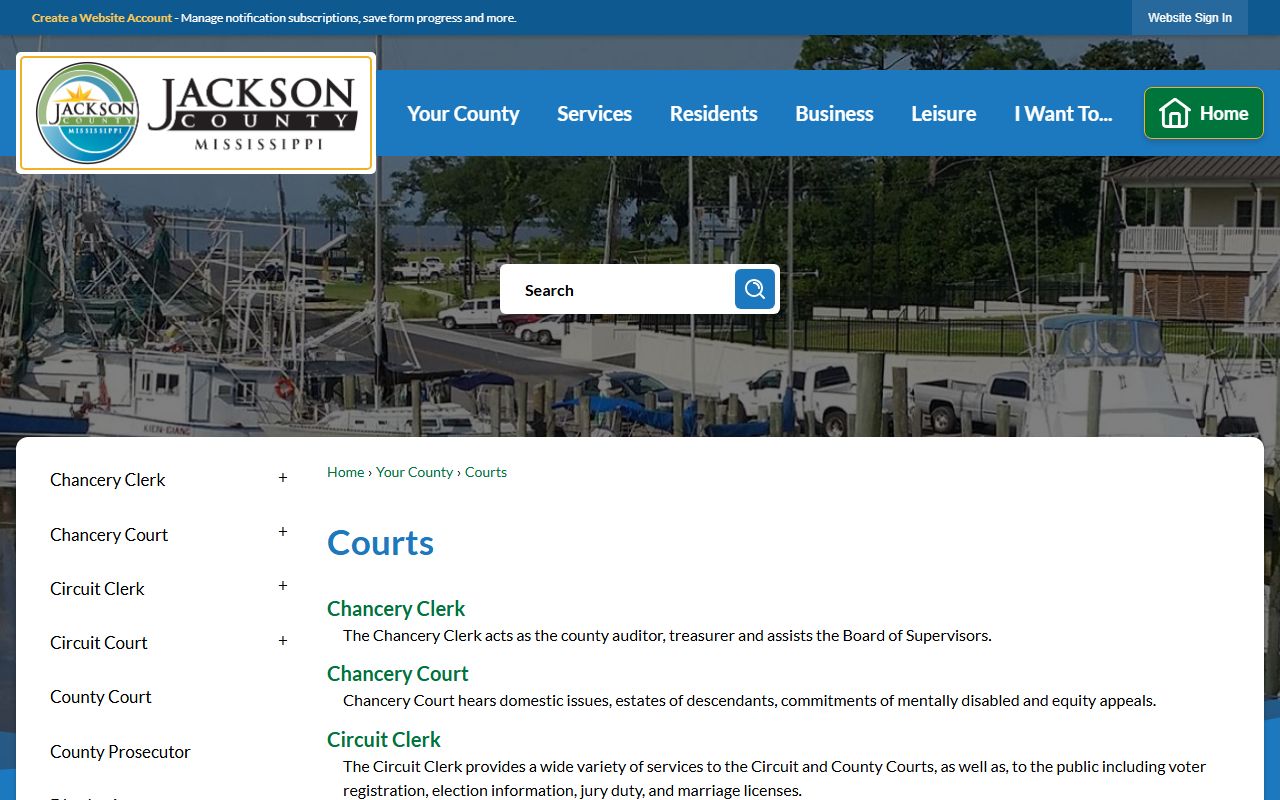
That court structure matters because a misdemeanor, a felony preliminary matter, and an indicted felony can move through different offices even when they began with the same jail arrest.
How to Find Jackson County Court Records After an Arrest
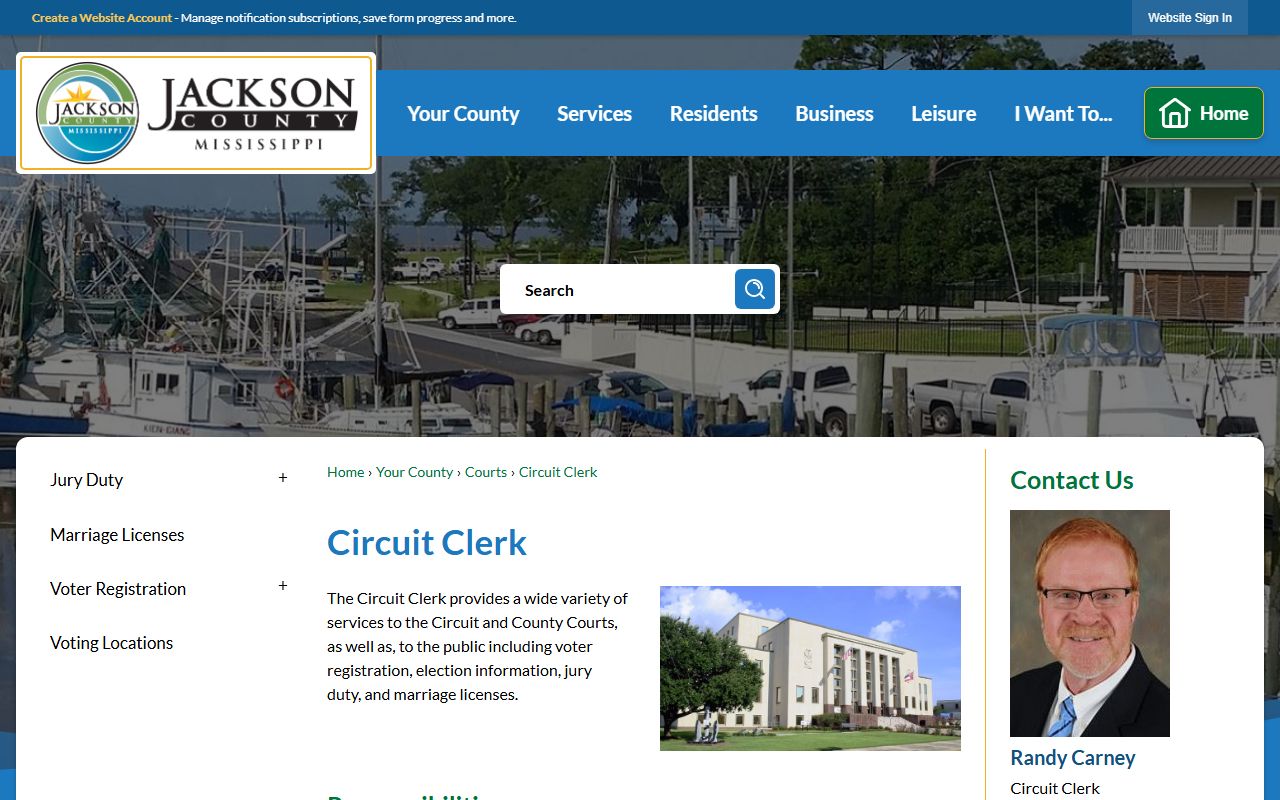
For filed court records after an arrest, start with the court system rather than the jail roster. Mississippi Electronic Courts, at courts.ms.gov/mec/mec.php, is the state MEC portal used for Jackson County Circuit and Chancery Court search and login access. Full access may require an account, login, or fees, so the practical fallback is the Circuit Clerk. Circuit Clerk Randy Carney maintains the general court docket, receives and preserves court papers, keeps orders of the court, and maintains a complete record of proceedings for Circuit Court records. The Circuit Clerk page lists phone 228-769-3040 and public office hours Monday through Friday, 8 a.m. to 5 p.m.
- Confirm the booking layer first if custody is still in question: full name spelling, booking date, arresting agency, and any charge wording shown by the jail.
- Open the MEC portal or contact the Circuit Clerk if the case may be in Circuit Court, especially for felony charges or appeals from County Court.
- Search by defendant name or case number when available, then match the result against the booking date, prosecutor, and court division.
- Open the case record and read the charge list, docket events, bond orders, hearing settings, and any disposition entries.
- Check each charge separately because one count may remain pending while another is reduced, dismissed, or resolved by plea.
The Circuit Clerk page is the local source for docket and records responsibilities, including the office address at 3104 Magnolia Street in Pascagoula and the mailing address at P.O. Box 998, Pascagoula, MS 39568-0998.
Statewide custody tools serve different purposes. The Mississippi Department of Corrections locator at ms.gov/mdoc/inmate/search/index is for sentenced state custody, including MDOC placements such as the Pascagoula Restitution Center, not for a newly booked county pretrial detainee. Mississippi VINELink is available statewide at vinelink.com/#/home/site/25000 for custody notification, but it is not a substitute for the filed criminal case record.
| Search Channel | Best Use | Limits |
|---|---|---|
| Mississippi Electronic Courts | Circuit and Chancery Court case search or login access for filed court records. | Access may require registration, login, or fees. |
| Circuit Clerk | Docket, case-file, order, and local records questions for Circuit Court. | Clerk staff can identify records access procedures, but cannot give legal advice. |
| County or Justice Court | Misdemeanors, preliminary hearings, and lower-court criminal matters. | Search path depends on which court issued the setting, warrant, or order. |
| Chancery Search | Chancery matters by case number, party name, styled defendant or plaintiff, filed date, final disposition date, docket, file number, and refinements. | Mainly Chancery, not the primary criminal felony portal. |
How Charges Get Filed After an Arrest: Complaint, Information, and Indictment
After an arrest, the jail booking entry can preserve the first public description of the alleged offense, but the court record turns on the charging document. County-area Justice and County Court matters may involve the County Prosecutor, whose office represents the State in felony investigations, preliminary hearings, county court criminal cases, appeals, and misdemeanors for cases occurring outside incorporated areas. Felony prosecution moves to the District Attorney in Circuit Court. The document type affects how the charge enters the record and what should be checked next.
| Complaint | Information | Indictment | |
|---|---|---|---|
| Filed By | Officer or prosecutor, depending on the court and charge. | Prosecutor, usually after review of the case file. | Grand jury after felony review. |
| Common For | Misdemeanors, initial lower-court matters, and preliminary proceedings. | Formal prosecutor-filed charges when allowed by procedure. | Felony cases that move into Circuit Court after grand jury action. |
| Starts | A court case or lower-court proceeding after arrest. | A formal prosecution in the selected court. | A Circuit Court felony case based on the grand jury's charging decision. |
| What to Compare | Compare complaint wording to the jail booking charge. | Check whether the information amends or narrows the booking charge. | Check every count because an indictment may differ from the original arrest wording. |
The Circuit Court page identifies Jackson County Circuit Court jurisdiction, judges, court terms, and the courthouse address for felony and appeal matters.
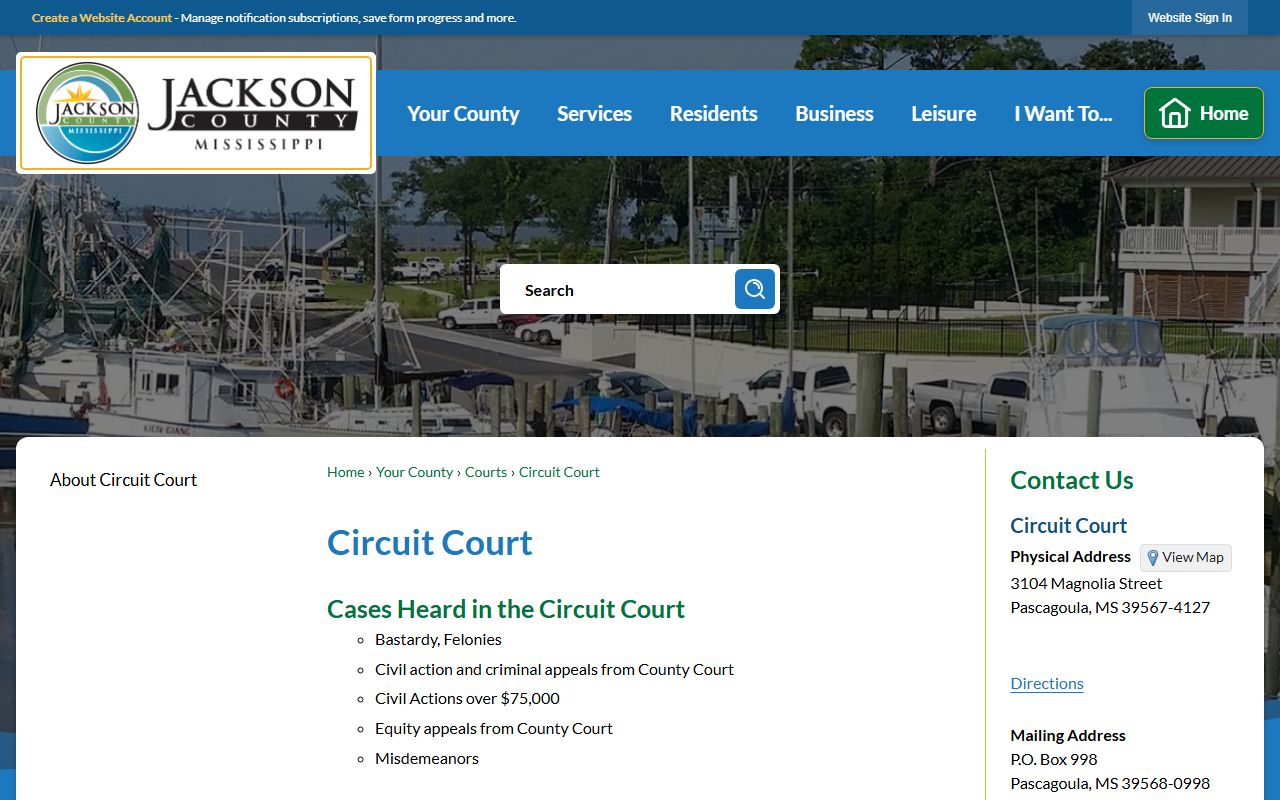
Circuit Court terms begin in January, April, July, and October and run for eight weeks. The county page lists Judges Calvin Taylor, Kathy Jackson, and Keith Miller, and identifies the courthouse at 3104 Magnolia Street in Pascagoula.
Charge Status and What It Means
Charge status can change several times after a jail arrest. A roster may show the booking charge supplied at intake, while a prosecutor may later file a different count, add a count, reduce a count, dismiss a count, or decline to pursue the matter. This is why court records after an arrest must be read by count, not just by the first charge label found on a jail roster card.
| Status | What It Means |
|---|---|
| Pending | The charge has been filed or remains active, and the court has not entered a final disposition for that count. |
| Amended / Reduced | The prosecutor or court record shows a changed charge, often with different wording, level, or statutory basis from the booking entry. |
| Dismissed | The court has ended that count without a conviction on that charge, although other counts in the same case may continue. |
| Nolle Prosequi | The prosecutor has chosen not to proceed on that count. The docket should be checked for whether the order applies to one charge or the whole case. |
| Disposed | The charge has reached a recorded outcome, such as plea, verdict, dismissal, or other final court action. |
Bond and Release After an Arrest
Bond is set by court authority, usually after booking, first appearance, or through a warrant or court order. The jail roster may show custody and booking information, but bond terms come from the judge or court document. Jackson County's official Inmate Lookup page includes a specific bond scam warning: the Sheriff's Office accepts cash for bonds only at the facility, does not accept other forms of bond payment, and will not call or solicit payment by phone. Commissary, phone, kiosk, NCIC, TouchPay, CorrectPay, or messaging payments should not be confused with bond.
| Bond Type | How It Works |
|---|---|
| Cash Bond | The full cash amount is posted as directed. Jackson County warns that sheriff-accepted bond cash is accepted only at the facility. |
| Surety Bond | A licensed bail bond company may post a surety bond for a fee when the court allows it. Confirm local acceptance and conditions before relying on it. |
| PR / Own Recognizance | The court releases the defendant on a promise to appear, subject to the judge's order and any conditions imposed. |
| No-Bond Hold | Release is not available until the court or holding agency clears the hold. This may involve serious charges, warrants, probation or parole holds, another county, or federal or immigration detainers. |
Warrants That Lead to an Arrest
An arrest warrant or bench warrant can be the reason a person appears in the Jackson County Adult Detention Center. No official active online warrant search was located in the inspected Jackson County sheriff and county source set. The staff directory identifies a warrants role inside Criminal Investigations: Jadyn Wade, Warrants, phone 228-769-3162. The Sheriff's main number is 228-769-3063, and the Adult Detention Center 24-hour custody number is 228-769-3052 after someone has been booked.
Bench warrants may be held by the court that issued the missed date or order, which could be Municipal, Justice, County, or Circuit Court depending on the underlying case. A person trying to resolve a warrant should contact the issuing court or an attorney and verify appearance and bond requirements before traveling to the jail. Active investigative materials and some warrant details may be restricted until service or filing. For emergencies or an active arrest situation, call 911.
Charges vs. Convictions
Being arrested and charged in Jackson County is not the same as being convicted. A charge is an accusation placed into a court record after law-enforcement and prosecutor review. A conviction requires a guilty plea, verdict, or other court disposition that establishes guilt for that charge. Background checkers, employers, landlords, and members of the public can misunderstand this distinction, so the docket should be read for the final disposition, not just the original arrest or booking charge.
| Charge | Conviction | |
|---|---|---|
| Stage | Accusation after arrest, complaint, information, indictment, or other filing. | Final outcome after plea, verdict, or qualifying court disposition. |
| Burden of Proof | Lower threshold at arrest and filing stages, depending on the proceeding. | Criminal conviction requires proof beyond a reasonable doubt or a valid guilty plea. |
| Public Record | Often public unless sealed, expunged, juvenile, investigative, or otherwise restricted. | Often public unless later restricted by law or court order. |
| How to Verify | Read the charging document and current docket status. | Read the disposition, judgment, sentencing order, or final docket entry. |
Sealed vs. Expunged Arrest and Court Records
Mississippi public-records law generally makes public records available for inspection unless an exemption applies, but criminal records can become restricted in specific circumstances. Miss. Code Ann. Section 99-19-71 allows expunction of certain dismissed, dropped, no-disposition, not-guilty, and qualifying conviction records. Eligibility depends on the charge, outcome, prior record, waiting periods, and court order. A person seeking to restrict Jackson County court records after an arrest should rely on the court file and legal advice rather than assuming a dismissal automatically removes every record from every system.
| Sealed | Expunged | |
|---|---|---|
| Visibility | Hidden or limited from ordinary public access by court order or statute. | Removed from public treatment to the extent Mississippi expunction law and the order allow. |
| Law Enforcement | May remain available to authorized agencies under limited circumstances. | May still have limited legal exceptions depending on the order and record type. |
| Eligibility | Depends on juvenile status, protective orders, court restriction, investigative exemptions, or other legal limits. | Depends on Miss. Code Ann. Section 99-19-71 and the exact dismissal, no-disposition, not-guilty, dropped charge, or qualifying conviction. |
| Practical Step | Ask the clerk how public access is restricted for the specific case number. | File or review the expunction order in the court that handled the case. |
Background Check Considerations
Casual court-record lookup is not the same as a legally compliant background check. Mississippi court and jail sources may show pieces of a person's criminal history, but they may not reflect sealed records, expunged records, out-of-county cases, out-of-state cases, pending corrections, or records restricted by law. For employment, housing, credit, insurance, licensing, or other regulated screening, use a provider and process that complies with the Fair Credit Reporting Act and any state or local requirements.
Important: This site is not a consumer reporting agency and cannot be used for FCRA-regulated screening decisions.
Restricted Court Records After an Arrest in Jackson County
Not every arrest-related record is public in full. Mississippi's Public Records Act recognizes public access, but law-enforcement exemptions can affect investigative reports and sensitive materials. Juvenile matters, sealed cases, expunged records, confidential victim information, medical or security details, and active investigative files may be withheld or redacted. Booking photos may exist under criminal-history processing rules even when not posted online, but Mississippi law located in the research does not create a blanket requirement that every booking photo be published on the internet.
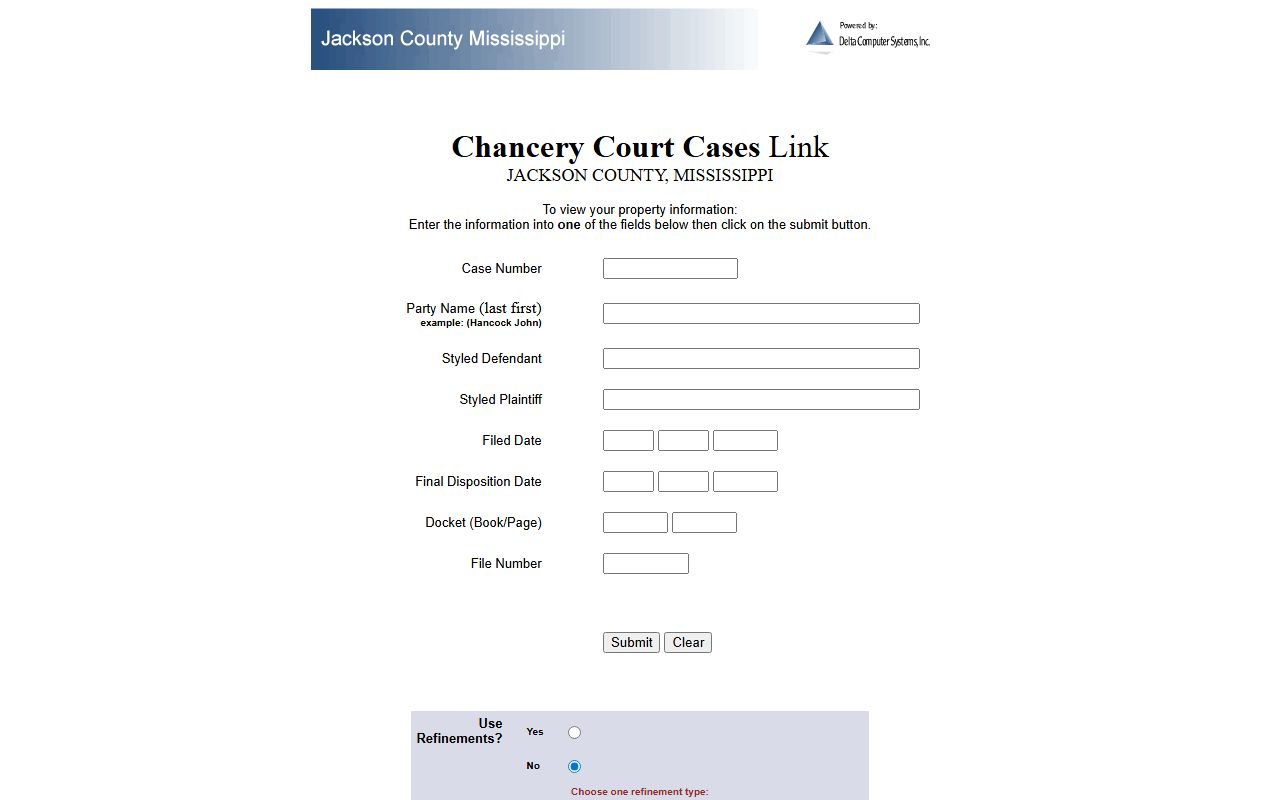
The Chancery search linked by Jackson County is useful for the record types it covers, with fields for case number, party name, styled defendant, styled plaintiff, filed date, final disposition date, docket, file number, and refinements. It should not be treated as the primary felony criminal portal. The source is still useful because it shows how local case-search tools may separate court divisions and record categories.
The official Chancery case search is linked at deltacomputersystems.com/ms/ms30/mclinkquerych.html and displays the field structure used for that Chancery index.
For criminal court records after an arrest, keep the division straight: Circuit Court and the criminal lower courts control the filed criminal case, while the jail controls the custody entry.